Showing posts with label bee attractor. Show all posts

Saturday, 19 April 2014

Horticultural highlight of the week (2014 week 15) - Clematis Alpina 'Frances Rivis'

Already mentioned as 'plant of the week' back in May 2013, this beautiful clematis just keeps getting better every year. It's flowered about a month earlier this year, probably because we had a very mild winter this year. Last year we had a severe winter with some late frosts. Fascinating that this variation can shift the flowering period so dramatically.

I've already described this clematis in some detail - follow this link for the original post. I am going to attempt to take some cuttings of this to bring to the new garden. Watch this space for the results.

Here's a photo of the blooms this year - more impressive than last year.

Clematis Alpina 'Frances Rivis'
Of course, I have added some macro shots of the flowers this time too.

Clematis Alpina 'Frances Rivis' - closeup of stamens - squidcam macro lens

Clematis Alpina 'Frances Rivis' - closeup of flower - squidcam macro lens


Thursday, 17 April 2014

Horticultural highlight of the week (2014 week 14) - Mahonia (unknown variety)

The mahonia in our garden was already well-established when we moved here seven years ago, although it was crowded out by a tangle over overgrown roses and a 30ft leylandii (which we had removed immediately - as it was only 10ft from the back of the house.

Since then the mahonia has thrived, although I think it doesn't like shade - it against a north facing fence and grows out away from it as if its stretching for the light.

It's positioned right by the back doors - which means we are able to appreciate the amazing display of colour (and more importantly its heady sweet scent) even when its too cold to amble out into the garden in the morning.

Mahonia (unknown variety)
Mahonia (unknown variety) in full bloom
The amazingly intense flowers are very short-lived lasting maybe just one or two weeks before they fade, however the blooms transform into delicate metallic purple-blue berries (probably poisonous) which reach full size by autumn.

The bush itself is a compact 4ft high dense clump of evergreen (but very prickly) leaves. The dead leaves do not break down well as they are thick and waxy like holly leaves, so watch out when clearing up underneath the bush - the leaves have been the cause of some foul language they are that sharp!

Another one I will be repeating in the new garden - I managed to take three successful cuttings last year - it seems to respond well to this. I also sends out shoots underground so small saplings appear all around it.

Of course I have some lovely macro shots of the flower buds taken in February as well as some of the opened flowers taken in early April. Macro shots were taken with my iPhone 5 and squidcam macro lens

Mahonia flower buds
Mahonia flower buds (closeup taken with squidcam macro)

Mahonia flower buds
Mahonia flower buds (closeup taken with squidcam macro)

Mahonia flowers
Mahonia flowers (closeup taken with squidcam macro)


Tuesday, 8 April 2014

Horticultural highlight of the week (2014 week 12) - Honesty (Lunaria annua)

The silvery seed pods of honesty remind me of secondary school art lessons - still life drawing in particular. Drape a cloth over some boxes on a table, add one violin, a sheeps skull, some other random objects 'acquired' from the biology room and garnish with some dead stems of honesty. Also known as 'silver dollar' the seed pods are silvery and papery, you probably know them even if you can't put that name to them.

Much as I loved still life drawing, I now prefer honesty flowers and they are now one of the earliest splashes of colour in the garden. They are incredibly good at self-seeding - they now exist in all the places where I didn't originally plant them (including growing out of cracks between the house and paving. If you get enough of them they create an amazing purple mist that attracts bees and butterflies.

Honesty (lunaria annua)

Honesty (Lunaria annua) - self-seeded in a dry patch by the greenhouse
They can start to look a bit scraggy one the flowering is over - which is a matter of weeks. It takes some time for the seed pods to mature - so there's a long period where they don't look their best.

I grew mine from seed, bought from Thompson & Morgan. They are perennial, and don't flower in the first year but they are super-easy to grow and once you have them, you've got them for life.

And here's the gratuitous close-up (of course taken with my squidcam macro lens)...

Honesty (lunaria annua) - close up taken with squidcam macro lens

Sunday, 9 March 2014

Horticultural highlight of the Week (2014 week 10) - Primrose (Primula vulgaris)

This is one of my favourite and best-loved native wildflowers and sit heads and shoulders above the gaudily coloured 'polyanthus' seen in cultivated beds on many a British roundabout and village green. Here in Sussex the advent of spring is marked by numerous clumps of primroses as much as it is by swathes of daffodils and I was very happy when one decided to self-seed itself in my herb garden.

Primrose (primula vulgaris) caught in March sunshine
That was about four years ago, and after the first year, and my efforts to carefully transplant the tiny flowerless offspring of the initial coloniser, they are now firmly established in the garden. It appears to favour well-drained soil and partial shade where it thrives - the plants that have seeded in the part-shaded gravel areas in the garden seem to be stronger and more upright, as seen here where one has appeared in the gravel surrounding the greenhouse.

Primrose (primula vulgaris)
I've now got tens of plants that appear in shady corners of the garden every spring - one of the first real signs that warmer weather is on its way.

Of course the 2014 editions of 'plant of the week wouldn't be complete without a couple of squidcam macro shots.

Primrose (Primula vulgaris) taken with Squidcam macro lens

Primrose (Primula vulgaris) taken with Squidcam macro lens

Monday, 24 February 2014

Back in the garden again - first time in 2014

So this weekend I managed to get out in the garden at last. First time since November! My attempts at any garden activity had been hampered by three major events:

  1. A fantastic holiday in Tobago over Christmas and New Year
  2. Minor surgery on my leg which meant I wasn't able to walk for a couple of weeks.
  3. The worst wind and rain in the UK I have ever seen - meaning the lawn was just too flooded and muddy to be able to walk on it much.
Fences need repairing, the greenhouse needed glass replacing and the lawn in in some serious need of TLC.

First job of the year was to turn the raised bed over to wild flowers for the year. With the potential that we may be selling up and may not see the whole year out in this garden, the vegetable patch will become a wild area.

Wildflower seed packs - butterfly and bumble bee attractor plants
I bought two packs of wildflower seeds from the RSPB online shop. One pack of butterfly attractor wildflowers and one pack of bumble bee attractor wildflowers. Not the cheapest of seed packs but at least the money goes to a very worthwhile charity, and I love bumble bees.

Hopefully I will get to see some of these flower before we move!

These two packs covered an area about 4 square meters in the raised vegetable patch, minimum effort and maximum insect attractors. Did I mention that I love bumble bees?


Thursday, 3 October 2013

Plant of the Week - Clematis 'unknown variety'

It's fantastic that there are still flowers in my garden into early october, it keeps the bees visiting! This clematis was in the garden before I was here and is growing through the hedge by the patio along with a rogue honeysuckle, which is also still flowering. It hides away for most of the year and its foliage and flowers only appear from inside the hedge come early autumn, like a last-minute dinner making a grand entrance.

I have no idea what type of clematis this is if anyone can identify it for me I'd be most grateful.

Clematis - 'unknown'

I love it because its late flowers offer a brilliant opportunity to get some close-ups of the insects that are visiting the flowers. They seem less bothered by my camera lens nosing in on them while they gather pollen and nectar at this time of year. I can sense their instinct that time is running out and their feeding time of year is drawing to a close. Today I saw hoverflies, bumblebees, wasps and several honey bees like the one below.

Clematis flower with honey bee
I'm planning to take several cuttings of this plant so that I can grow one over the fence on the opposite side, which is bare at the moment (my Clematis 'Oberon') seems to have died. The leaves are thick and a beautiful green with a lovely soft serrated edge. The freshness of this plant really stands out in the garden at this time of year.

Clematis unknown - flowers and foliage
Clematis 'unknown' - flowers and foliage


Friday, 27 September 2013

Plant of the week - Oenothera (Evening Primrose)

There's still a lot going on in my garden at the end of September, but my choice for this week took me by surprise. The evening primrose has had a second wind and exploded in a flurry of large yellow flowers - it had already flowered in late summer, producing blooms at a fairly modest rate, but it looks like this is it's 'swan song'.

Evening Primrose - Oenethera
What's also unusual is that its flowers are open during the day, rather than opening during the late evening as it did during the summer (hence it's name). This means it's being visited by bees rather than moths as you can see on the right hand side of the shot above. It feels like this one was desperate to stock up for the winter months - visiting every flower several times to make sure none were overlooked.

It was hanging around long enough for me to capture some great shots of it, body and legs dripping in pollen, gorging itself inside one of the flowers.

Evening primrose & Buff-tailed bumblebee queen
Evening primrose & Buff-tailed bumblebee (queen)
Evening primrose & Buff-tailed bumblebee queen
Evening primrose & Buff-tailed bumblebee (queen)
I pinched some seeds that were growing wild by the road at the end of the street. That was last year, and I already have mature plants. I suspect these will be self-seeding and start to pop up everywhere but I really don't mind!

Thursday, 19 September 2013

Plant of the week - Nasturtium (Tropaeolum majus)

A belated post from last week - 12th september

Strange to say that I was hard pushed to decide on the plant for this week. It may be mid-september but there's still lots going on and lots of little beauties popping up as autumn takes a grip.

What caught my eye this week was a clump of little nasturtiums tucked away in the strawberry patch and this especially bright specimen (not PhotoShop enhanced honestly!).

Nasturtium Tropaeolum majus
Nasturtium (Tropaeolum majus)
When there's not much colour in the garden that really jumps out at you, this is a little star. I remember chucking some nasturtium seeds in this spot sometime in June when I was having a clearout of old seeds. They are so resilient they don't need any care and will obviously just grow where you throw them.

They are humble plants and often overlooked, but there are some fantastic varieties about and they will self-seed year on year although I am not sure how true the colours are for second and third generation etc.

The best bit about nasturtiums is that you can eat the flowers! They have a slight peppery taste, but they look amazing in a green salad - just make sure they aren't covered in blackfly as mine usually are if they are blooming in mid-summer.

Thursday, 29 August 2013

Plant of the week - Blackberry 'Loch Ness'

This weeks' plant is another edible - as there are plenty of sweet juicy fruit in the garden at the moment!

Everyone loves blackberries and we all have childhood (or even adult) memories of picking brambles and cramming them into our mouths, coming home with fingers stained in the deliciously tart purple juice. They are a key ingredient in many a fruit pie and one of the true edible wonders of the British countryside.

Brambles grow everywhere in my garden, I have tough job getting rid of them as they are so invasive. For a couple of years I let them get on with it in one or two remote parts of the garden so that I could gather the fruit for a crumble. But what I didn't like was the scratches and cuts from the thorns. So I invested in a cultivated variety...
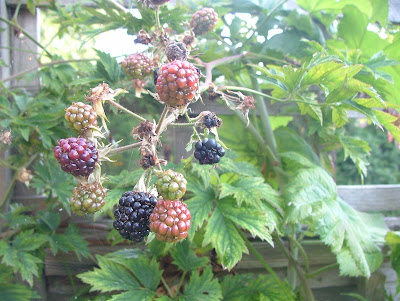
Blackberry - Loch Ness
'Loch Ness' really does produce amazingly sweet and juicy fruit, the blackberries are a gorgeous rich velvety black (almost tar-like) colour, and the fruits appear in proliferation. It's thornless, so even little ones (or careless big ones) can pick the fruit without worry of a scratch, its just the spiders you have to watch for when you pop them in your mouth - better to rinse and be safe.

I got mine from Crocus, about 3 years ago, and this year it has really come into its own and produced a bumper crop - the first two years were a bit disappointing, but there are already promises of a good crop next year from the tall strong news stems that have appeared this year. It fruits on the previous year's growth, so once a stem has fruited it needs to be cut back to the ground - taking care not to remove the new stems that will produce fruit the following year.

It doesn't seem to mind the shade - as its growing on a north-east facing wall along with a loganberry. It makes good use of the shady fence that would otherwise be bare.

Bowl of blackberries - Loch Ness
Bowl of blackberries - 'Loch Ness'

We've already had about 1kg of fruit from one plant - and there are more berries to come. And as if that's not enough, the maple-like leaves become a vibrant shade of orange in autumn before the leaves drop! You can't go wrong...


Saturday, 24 August 2013

Plant of the week Blueberry 'Bluecrop'

If I had to recommend just one of the edible plants in my garden then there is no doubt that it would be the blueberry. Even if you have small garden or patio,  there's no excuse as they don't take up much space. Blueberries can be quite expensive in the shops but the plant itself requires very little care other than the acid soil it grows in so growing your own is cost-effective.

I've had mine for about 4 years now and like all fruit bushes, it produces more crop year on year. It's outside in full sun in a pot filled with ericaceous (acid) compost and I only ever water it with rain water (tap water is too alkaline I read somewhere). I do feed it just as its flowering with an ericaceous plant feed.

Blueberry bluecrop
Blueberry 'Bluecrop' - in a pot filled with ericaceous compost
 I got this plant from Crocus - it came in a small pot - the plant was about a quarter the size it is now. I selected this variety for its heavy cropping and the fact that it self pollinates. I'd read that some blueberries need a partner to help them produce fruit but this has done well all by itself!

The wood pigeons love them - there are a pair of fat ones nearby who are always looking a bit pleased with themselves - probably responsible for eating the entire cherry crop too. But despite this we still managed to get a few bowls full of berries - probably about 1.5kg all in all.

Bowl of blueberries - bluecrop
A bowl of delicious blueberries!
Best of all they taste delicious - I only pick them when very ripe - so each one is full of flavour - unlike the supermarket packs which sometimes have 50% bland tasting berries - we have them in crumbles and best of all - with greek yogurt and honey.

Go on - try one at home - I promise you won't be disappointed!

Thursday, 18 July 2013

Plant of the week - Strawberry 'Cambridge Favourite'

Everyone knows you can't beat British strawberries when they are in season. And even better when you can pick them yourself and eat them within seconds of them being picked! Much tastier than the supermarket varieties which have been chilled, travelled and sat around in plastic punnets, the taste of warm fresh strawberries reminds me of going on 'pick your own' expeditions as a child, where the object was to eat as many strawberries as you could without being sick instead of popping them in the basket to pay for them.

I bought three strawberry plants from my local garden centre 'Garden Pride' four years ago. From cultivating the runners and allowing them to spread, I now have a 3 metre long bed full of strawberry plants - the result of my daughter planting twenty plants in the ground two years ago.

First bowl of strawberries 2013 - 'Cambridge Favourite'
I don't give them much care, although they do get attacked by slugs - the wet summer of 2012 meant that most of the strawberries were eaten before they were ready to eat. This year the slugs haven't had much of a chance as July has been exceptionally hot and dry, instead there are a plethora of woodlice eating themselves little hidey-holes in the delicious red berries - disappointingly, some of the reddest berries turn out to be hollow on closer inspection! They taste delicious, even when they aren't quite the traditional pillar-box red - but have to be eaten quickly as they don't last long chilled.

I read that strawberries aren't technically berries. I remember learning in school about the anatomy of a buttercup flower, which is related to the strawberry I think - where the seeds are on the outside of the enlarged flower receptacle. Strange but true!

Thursday, 11 July 2013

Plant of the week - Delphinium 'Pacific Giants Mixed'

I tried growing these delphiniums from seeds when I was about twelve years old and can still remember my failure and disappointment to this day. Nigella and calendula were my limits of horticultural expertise way back then.

So of course there's a little bit extra in my smile when I look at these now in my garden, having managed to successful germinate and nurture them to bloom at the age of erm.... twelvety-something. Delphiniums are not the easiest to germinate, but after following the instruction to cover with vermiculite, place the seed tray inside a clear plastic bag (and then kept inside) eventually paid off. I now have about six handsome specimens, which somehow all appeared as shades of blue despite the multicoloured affair shown on the seed packet.

Delphinium 'Pacific Giants Mixed'
My trick to keeping them going has been to protect the young shoots of the plants every spring by means of copper rings. I now have a fine display of blues at the back of the border.


Best of all - bees love 'em! I got my seeds from Thompson and Morgan.

Monday, 8 July 2013

Plant of the week - Sweet William 'Sooty' - Dianthus barbatus nigrescens

Sweet william is a favourite of mine, but this variety puts a twist on the traditional cottage garden classic. I originally bought seed packet of both a mixed assortment and this 'black' variety. After the initial wait of sowing seeds and nurturing them to their first bloom in their second year, they now seed themselves and appear in the garden in various spots spreading their cheery pink, white and red cushions of blooms which of course are a magnet for bees and butterflies.

Sweet William 'Sooty' - Dianthus barbatus nigrescens
The rich velvety tones you can see in this photo are actually from a third generation sowing of 'Sooty', so this offspring is not true to the darker blacker originals, but it has a beauty of its own making, a deep intense red that Anish Kapoor would be envious of. The stems have a dark ruddy-purple hue as do the leaves, making them a fantastic plant to contrast against a pale foliage or white flowers.

I don't treat these as biennials, but more like the perennials they really are, so I keep them going for a few years. They do get a big straggly from their third year but if they are mixed in with other similar hight plants (mine are next to the crocosmia and contrast well with their dagger-like leaves) then you wouldn't notice their raggedy behaviour.

I bought the original seeds from Thompson & Morgan.

Wednesday, 19 June 2013

Plant of the week (belated) - Poached Egg Plant (Limnanthes douglasii)

A little belated, but plant of the week for week ending 14th June 2013 is the humble poached egg plant. This little self-seeder appears everywhere in the garden now and I usually leave it to its own business. It seems to prefer drier stonier places in the garden where other plants find it hard to survive, like gravel borders and has even colonised and survived uncared for in the dry gravel floor of the greenhouse.

Poached Egg Plant (Limnanthes douglasii)

It's a modest little plant but bees love the cheerful yellow and white flowers, which makes it a hit in my garden.

I got a single seed packet from Thompson & Morgan a couple of years ago, but never had to buy seeds again as its now established itself in the garden without any additional help!